
Writing With My Head: How the Quha Zono X Keeps Me Connected to the World

By Ayoposi OjelabiAuthor and Patient Voice Essayist
When Writing Became Difficult
Writing was not something I planned to do. It began during rehabilitation after a prolonged and difficult period of illness, when I needed an outlet for my anger, a way to document what had happened to me, and something meaningful to occupy my time.
I live with Chronic Inflammatory Demyelinating Polyneuropathy (CIDP), a neurological condition that severely affected my physical abilities. Despite extensive treatment, including a stem cell transplant, my recovery took a difficult turn. I experienced respiratory failure, needed a tracheostomy and spent approximately ten months in intensive care across four hospitals. I lost the use of my hands to the extent that typing became impossible.
Before my illness, I had worked in computer networking. Technology was familiar to me, and I was accustomed to solving technical problems. I did not expect to find myself in a position where I could no longer operate a keyboard or reliably use the touchscreen on my phone.
But that was my reality.
During rehabilitation, two care staff members helped me begin writing. I would dictate my thoughts, and they would type them for me. I remain grateful to them because, without their help, some of my earliest writing might never have existed.
However, there was a limitation. The arrangement depended on another person being available.
Sometimes I would wake at three in the morning with a memory from intensive care or something important that I wanted to document. I knew that if I did not record it, the thought might disappear by morning. But the people who could help me type were not there.
I began to understand that I needed more than assistance with writing. I needed access to writing when I wanted it.
That distinction would change the direction of my life.
The First Quha Zono: Finding My Way Back to Writing
Through a referral from Salford Royal, I was introduced to the North West Assistive Technology Service (NWAT). After an assessment, I was provided with a head-tracking system using the Quha Zono head mouse. It connected to my laptop by USB, with a small sensor attached to my glasses. My head movements controlled the cursor on the screen.
For someone like me who could no longer use their hands to type, this opened up a possibility I had been missing.
I could move the cursor, interact with the computer and begin writing without requiring another person to operate the keyboard for me.
The significance was difficult to explain to someone who had never experienced the loss of access to their own thoughts. My hands had not recovered. My illness had not disappeared. I still needed substantial physical assistance.
But my thoughts no longer had to wait for someone else to be available before they could become words on a screen.
I could wake in the early hours, sit up and begin recording what was on my mind. I could return to a memory, develop an idea and work on a piece of writing at my own pace.
What began as a distraction during rehabilitation became something more substantial.
I started writing essays about my experiences of illness, disability, rehabilitation and identity. I went on to publish books and create my own website. Over time, writing became part of how I understood myself again.
When illness forced me to leave my job, I lost more than employment. I lost a familiar role and a significant part of the identity I had built around my work and abilities. I had to confront the question of what I could still contribute when the work I had trained for was no longer something I could do in the same way.
Writing gave me a new purpose.
Today, I identify as an author and patient voice essayist. I write about experiences that are often difficult to explain from the outside, with the hope that my work can help other people understand illness, disability and the realities of rebuilding a life after a major disruption.
The original Quha Zono made that writing journey possible. It gave me a way to work with my laptop when my hands could no longer do the job.
I will always regard that as a significant turning point.
An Unexpected Introduction to the Quha Zono X
My experience with the Quha Zono X began unexpectedly.
The North West Assistive Technology team arranged to visit me to deliver a mount for my existing setup. I assumed it would be a routine equipment appointment.
Instead, the engineer introduced me to the Quha Zono X.
The device offered something different from my existing setup: a head mouse that could switch between compatible devices. It could support access to devices such as a laptop, phone and tablet, with switching possible through a physical button or a head gesture.
Because of the limited function in my hands, pressing the button is not a practical option for me. The head gesture is therefore particularly important.
The first introduction was a learning experience for both of us. The engineer and I watched demonstration videos together, trying to understand how the switching mechanism worked. Even with the instructions and demonstration, I could not get it to work reliably on the first day.
That experience reminded me of something important about assistive technology. Watching a device being demonstrated is not the same as using it independently, especially when you have to learn a new movement or technique within the limits of your own physical abilities.
I could have seen that first attempt as a failure. Instead, I kept thinking about what we had seen. I needed more time.
The following day, I returned to the device and approached it more slowly. Rather than repeatedly trying to make it work, I concentrated on understanding what the device required.
Two things became clear.
First, the cursor needed to be completely still before I attempted to switch devices. Second, the head gesture had to be deliberate and completed through a sequence of four beeps. If I moved too quickly or stopped before the fourth beep, the sequence reset.
Once I understood the importance of keeping the cursor still and completing all four beeps, the switching process began to make sense.
It was a reminder that sometimes progress comes not from trying harder, but from understanding the problem differently.
From Learning the Gesture to Using It in Everyday Life
I am now using the Quha Zono X, and I can switch effectively between my laptop and phones.
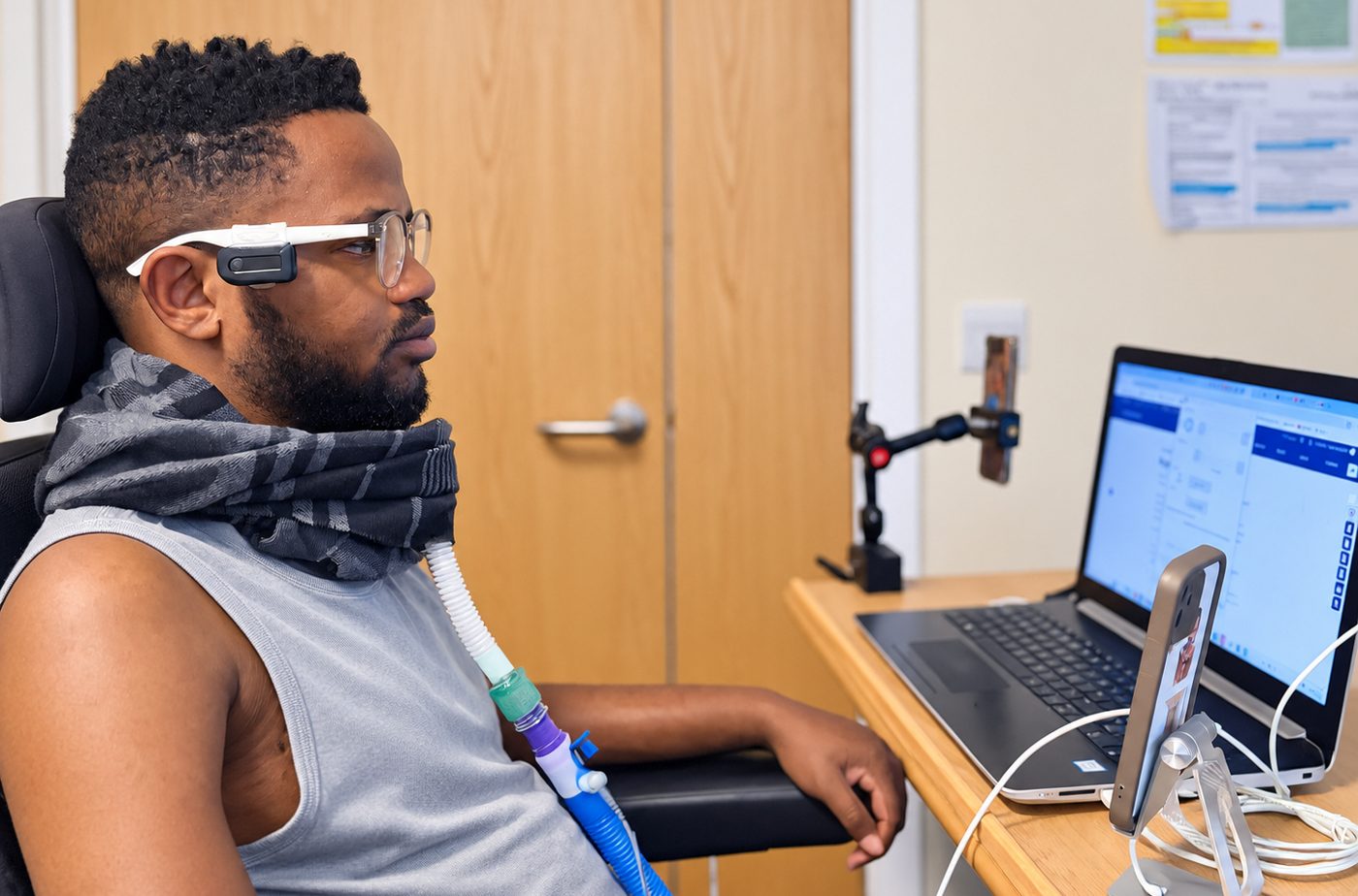
That matters because these devices serve different purposes in my life.
My laptop is where I write my books and essays and manage my website. It is where I develop ideas, organise my work and continue building my identity as an author and patient voice essayist.
My phone allows me to stay connected with family and friends. Those relationships matter just as much as my writing. Being able to reach people, communicate with them and maintain those connections is an important part of remaining involved in everyday life.
The ability to switch between devices means I can move between these different activities using the same assistive technology system, rather than treating each device as an entirely separate challenge.
For me, the value lies in what I can now do with it.
More Than a Cursor on a Screen
The Quha Zono X is one part of a wider assistive technology setup that helps me interact with my environment.
Working alongside other software and equipment, my setup gives me access to devices such as my television, fan and exercise leg bike, as well as other equipment I use.
It is important to distinguish between the functions of the individual devices and the wider system. The Quha Zono X provides a way to control and switch between compatible devices, while other software and equipment make additional forms of access possible.
Together, they help me do more from my room.
My physical world is restricted by my condition. I cannot simply reach out and operate devices with my hands, move around independently or approach everyday tasks in the way many people take for granted.
Technology provides another route.
My laptop, my phone and my wider setup may look like separate functions, but to me they are connected by one idea: access.
Access to work that matters to me. Access to relationships. Access to my surroundings. Access to the ability to make certain things happen for myself.
In practical terms, this is what the technology does. In personal terms, it allows me to continue participating in the world.
What Access Gave Back
The change was not only practical. Serious illness can quietly wear away your sense of who you are. When you depend on other people to type, to send messages or to speak for you, it is easy to feel like someone things happen to, rather than someone who makes things happen.
Being able to write when I choose, without waiting for anyone, gave some of that back. It restored a sense of agency, of purpose and of being the author of my own words.
I am careful not to claim more than that. The technology has not changed my diagnosis or my physical condition, and I am not suggesting it can treat or improve anyone’s health. But it has changed how I see my place in the world, and that matters to me as much as any practical benefit.
Independence Does Not Mean Doing Everything Alone
Living with significant disability has changed how I understand independence.
I still depend on carers, nurses, therapists and other people for many aspects of daily life. Assistive technology has not removed that need, and I would not want to suggest otherwise.
But I have learned that independence does not have to mean doing everything without help.
It can mean having control over some of the things that matter to you.
For a person who cannot use their hands to operate a computer, being able to write independently is meaningful. For someone who cannot easily reach a phone, being able to communicate when they choose is meaningful. For someone whose environment has become difficult to interact with physically, having another way to control devices can make a practical difference.
These are not small things simply because they may look ordinary to someone else.
The ability to decide when I want to write, to work on my website or to contact someone is part of having a say in my own life.
That is the distinction I want people to understand. I do not need to be completely independent to exercise control. I need access to the things I want and need to do, in ways that work for me.
Assistive technology can contribute to that access, provided it is considered in the context of the individual person rather than only as a piece of equipment.
What Could Be Better
The Zono X is not effortless, and I would rather say so honestly. The switching gesture takes practice and consistency. It is manageable for me now, but it was not at first.
The demonstration videos were not enough for me to get the gesture working. I worked it out by slowing down and watching what the device did. Clearer step-by-step guidance would make the Zono X easier to learn, explaining how to hold the cursor still, perform the switching gesture and recognise when the sequence has been completed. Guidance written for people with limited or no hand function would be particularly valuable.
I mention this because I want the device to work for people with more function than I have, and for people with less.
What I Would Want Professionals to Understand
My experience has also shaped how I think about assistive technology assessments and demonstrations.
A device may work during an appointment, but that does not automatically mean the person will find it easy to use in everyday life. The circumstances of a demonstration are different from the circumstances in which someone has to operate the device alone, perhaps when tired, frustrated or trying to complete a task that matters to them.
I believe it is important to give users room to learn, to ask questions and to explain what is and is not working for them.
It is also important to ask what the person actually wants to do.
For me, the answer was never simply to move a cursor. I wanted to write. I wanted to record my thoughts when they came to me. I wanted to publish books, build a website, communicate with people and continue developing a meaningful life after illness had changed so much about how I lived.
I would also encourage professionals not to underestimate the emotional importance of regaining access to an activity. For one person, it might mean being able to write a book. For another, it might mean sending a message without assistance, choosing what to watch on television or staying in touch with a loved one. The task may look small to someone observing it, but the difference it makes to the person using the technology can be substantial.
My background in computer networking helped me with the technical side, but technical familiarity should not be a requirement for wanting to communicate, work or take part in everyday life. People need solutions that work for their circumstances, with the right guidance and support.
The technology matters because it helps me pursue those aims. That is why the experience of the user should be central to any discussion about assistive technology. Technical capability is important, but its significance becomes clearer when we understand the life in which that capability will be used.
From My Room, Connected to the World
My life today is not the life I had before CIDP. I rely on a ventilator and need substantial support with daily activities. I cannot return to my previous work or physical abilities simply because I have found technology that helps me access a computer.
But my life has not stopped developing.
I continue to write. I continue to publish and develop my work. I manage my website. I stay connected with family and friends. I use technology to interact with parts of my environment that I cannot operate directly with my hands.
The original Quha Zono gave me a way to begin writing independently. The Quha Zono X has built on that foundation by giving me a practical way to switch between my laptop and phones. Alongside other assistive technology, it forms part of a system that helps me remain connected to the people, activities and work that matter to me.
I do not see this as a story about technology making disability disappear. It has not done that.
I see it as a story about what becomes possible when a person is given access that works for their circumstances, and when they have the opportunity to learn how to use it.
I write from my room, but my work reaches beyond it. I communicate with people who are not physically present. I maintain a website that others can visit. I publish writing that may reach someone who is experiencing a difficult period of illness and looking for a way to understand their own circumstances.
The room is where I live. It does not have to be the limit of my participation in the world.
For me, that is what assistive technology is ultimately about.
Not simply controlling a device, but having the means to do something meaningful with it.
The technology continues to develop. I continue to learn. And I continue to write.
About the Author
Ayoposi Ojelabi is an author and patient-voice essayist based in the United Kingdom. He lives with CIDP and writes about illness, recovery, rehabilitation and assistive technology, using a head-tracking system. His books are Still Here, Finding Strength in Numbness, Through Fire and Silence and When Daddy Works, which he wrote for his daughter, Tiara. His writing is at ayoposiojelabi.com.